

A book cover illustrator is losing rent money to AI. A translator who used to bill fifty hours a week is post-editing machine translations for a quarter of what real translation paid. A self-published author is watching her genre get colonized by operators churning AI bookspam under made-up randomized pen names.
Now look at the discourse that’s supposed to be helping them.
Three loud fights are going on around AI. Artists vs the image generators. Writers vs scraping and LLM generate text being so close to free it’s nearly impossible to compete with. Environmentalists vs the data centers. The anger is real, the harms are real, people are losing work.
I think all three fights are going to lose. Sorry to lead with the punchline.
Not because the anger is wrong. The anger is the right anger pointed at the wrong target, and naming the target as AI is keeping people from naming what’s underneath. Artists aren’t mad because AI makes art harder to make. They’re mad because AI makes art harder to get PAID for. Two different things that capitalism welded into one so tightly that most of us never noticed they were separate.
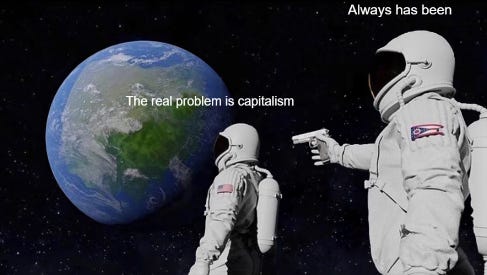
None of this is a knock on the people fighting (with some minor exceptions... which I’ll get to). They’re picking the closest available tool given what they think is on the table. The problem is what that tool actually does once you pick it up, which is mostly: nothing useful, and a little bit of damage to the people picking it up.
The Art Fight
Artists are getting properly hammered. Professional illustrators are losing work. Studios are using AI for concept art instead of paying concept artists. The freelance market for book covers is contracting. People who used to make rent doing this aren’t making rent anymore. The Studio Ghibli moment was the whole pattern in one image: a beloved aesthetic that thousands of human artists spent careers building, generated by anyone with a prompt box, at basically zero marginal cost, aimed at the exact market that used to pay those artists. (Miyazaki has been on the record about hating exactly this kind of thing for decades. Did not stop a single person from joyously generating “my family as Studio Ghibli characters” for the group chat.)
Both sides of the AI art debate keep saying things that sort of sound right, until you look at them for more than a second. Both sides leave gaps the other walks straight through. The anti-AI side says AI is theft and that it’s flooding everything with garbage. The pro-AI side says AI democratizes creativity and is just a tool. Each runs into a problem the other can’t solve.
“AI is theft” runs into “but human artists also learn from other artists, so where’s the line.” The lawsuits have been narrowing on that gap for years. Diffusion models don’t reproduce works the way the legal theory was built to catch them, and the courts keep narrowing the claims. Not a great trajectory for the people pinning their hopes on this fight.
“AI democratizes creativity” runs into “but the people who were making art for a living are losing their living, in what sense is that democratization.” The pro-AI side has to either ignore the displaced creators or argue that the gains to new amateurs outweigh the losses to professionals. Neither version survives looking the specific person who used to pay rent doing book covers in the face.
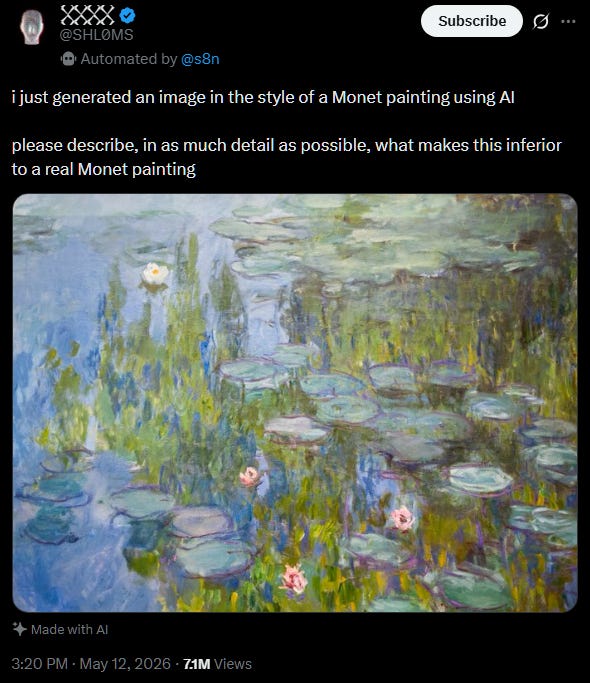
There’s a third claim worth its own beat: that AI just makes bad art. Mediocre. Soulless. Low-effort. You can spot it just by looking, apparently. The interesting thing about this claim is what happens when you test it. An X user posted a real Monet painting with the caption “I just generated an image in the style of a Monet painting using AI. Please describe, in as much detail as possible, what makes this inferior to a real Monet painting.” 6.7 million people saw it. The replies filled up with critics confidently identifying the obvious AI tells. The dead eyes. The soul-vacuum aesthetic. The way the brushwork was subtly wrong. One person wrote an 850-word breakdown of why the “AI” piece couldn’t hold a candle to actual Monet. Then the artist revealed it was actually just a photo of a real Monet, and the critics quietly deleted their replies. The tells they spotted weren’t tells. They were the critics filling in detail to support a conclusion they’d already reached.
Same with writing. The “I can always tell” claim doesn’t survive a blind test. People say a passage is bad when they’re told it’s AI and don’t say it’s bad when they aren’t.
None of this is to defend AI art or AI writing as good. There’s plenty of bad AI work. There’s also plenty of bad human work. The argument the discourse is having pretends to be about quality but is mostly about whether AI gets a free pass on whatever the standard would otherwise be. Quality critiques that stand on the work itself without needing the AI label to surface the badness exist. They’re just much rarer than critiques that need to know it’s AI before they can find the bad in the piece.
Each side has a gap because each side is arguing about AI when the question is something else. AI is a labor-cheapening technology. Capitalism is the system that decides who eats the cost of the cheapening. The same thing happened to home seamstresses with the sewing machine, to telephone operators when the call switching went automatic, to travel agents when booking moved online. The sewing machine wasn’t innocent of what happened to home textile workers. It also wasn’t the cause. The cause is a system where survival depends on selling labor, and any technology that makes labor cheaper to replicate produces the displacement we keep seeing.
AI doesn’t stop art. People will keep making art. People made art before there was a market for it and they’ll make art after. AI makes art harder to get paid for. That’s the complaint. We just keep saying the wrong half of it.
It’s fucking capitalism.
The Writing Fight
Copywriters are getting laid off in absolute waves. Marketing teams are dropping their freelance pools. The freelance writing market on Upwork is down around a third year over year, the biggest drop of any category on the platform. Entry-level work has basically evaporated, UK translators report income drops around forty percent. Some have gone from full-time hours to functionally zero, and the work that remains is mostly post-editing AI translations, which pays a quarter what real translation paid and takes about as long to do properly. So that’s nice. Amazon’s KDP is flooded with AI-generated bookspam, real authors drowning under operators churning hundreds of cheap titles under pen names. A Cambridge survey found that half of UK novelists think AI is likely to replace fiction work entirely. Over half of new articles online are AI-generated. At this rate, if I’m going to finish my novel about dead internet theory I’m gonna have to move quickly or relabel it as historical fiction.
Writers say AI is plagiarism, that the output is a smoothie of work that was never consented to being used. That’s the version that gets the most traction in writer communities, in the Authors Guild’s class action against OpenAI, in NaNoWriMo’s near-implosion over its AI position (it then REALLY died for unrelated reasons that are somehow WAY worse).
The strong version of that complaint is real: generative AI lets capital appropriate and automate accumulated human culture at unprecedented scale, while concentrating ownership of the result and weakening the bargaining position of every creator who provided the substrate. That part is right. The model was built by ingesting the outputs of millions of writers who weren’t paid for any of it. The output competes with their living. The people who own the model now hold leverage over markets the original writers used to make rent in. There’s something specific to “your labor was the substrate the technology displacing you was built on” that doesn’t really apply to a loom. Where the framing goes sideways is in the proposed fix. Treating capital-appropriating-and-concentrating as a copyright problem assumes copyright on its own can constrain capital. Spoiler: it can’t. Copyright has always disproportionately helped the folks at the top of the economic food-chain and thrown everyone else under the bus.
The big corporate IP holders are not fighting AI. They are licensing to it. News Corp signed with OpenAI. Reddit signed with Google around the same time it killed the third-party apps and forced down the moderator protest over the change. The Atlantic and Vox Media licensed. AP licensed. Axel Springer licensed. Pretty much all of them, except the Times, who decided to sue. Most corporate publishers looked at AI training and saw a revenue stream, then hired comms departments to tell everyone how worried they were. Vertical integration, baby.
In 2001 the New York Times argued, in a Supreme Court case called Tasini, that publishers should be allowed to redistribute freelance writers’ work to electronic databases without paying the original writers a cent extra. They argued it hard and lost. Now the same paper is suing OpenAI invoking the exact copyright protections they argued AGAINST when freelance writers were the ones trying to use them. Same paper. Same body of copyright law. Opposite side of it depending on whether they’re the corporation extracting from creators or the corporation being extracted from. Wild what a different vibe 20+ years and a switched chair will do to a deeply-held legal principle.
Hypocrisy is too small a word for it. A corporation flipping sides on the same principle depending on which side of the table it’s sitting on is just capital doing what capital does. We keep being surprised, which is embarrassing.
The history of US copyright is the history of corporate IP consolidation. Mickey Mouse Protection Act (the actual legal nickname, not me being cute). Sonny Bono Term Extension Act. Every major change in the law’s lifetime has been a deal that benefits corporate IP holders at the expense of the public domain and individual creators. Then there’s work-for-hire, where most working creative people don’t even own the copyright on their own labor in the first place. Cool tool.
Copyright HAS moved real money to working creators in some places. Music’s mechanical royalties. Screen actors’ residuals. The German collecting societies. The thing those have in common is that they layer collective bargaining and union infrastructure on top of copyright, turning it into something labor can use to set terms. Copyright on its own doesn’t do that. The AI lawsuits aren’t doing it either. They’re individual creators and the Authors Guild fighting through courts, with no organizing structure on the other side of a ruling that could turn a win into a wage.
Even a writer-favorable ruling won’t restore the labor markets that are already disappearing. The lawsuits are the wrong shape for the shape of the harm.
(Cory Doctorow has been saying this for years. So has Brian Merchant. So have Karen Hao, Paris Marx, Edward Ongweso Jr. They keep getting drowned out by the louder, simpler fight about whether AI is theft, which is exactly the fight the corporate IP holders are happy to let everyone else have while they cash the checks.)
It’s fucking capitalism. Again.
The Water Fight
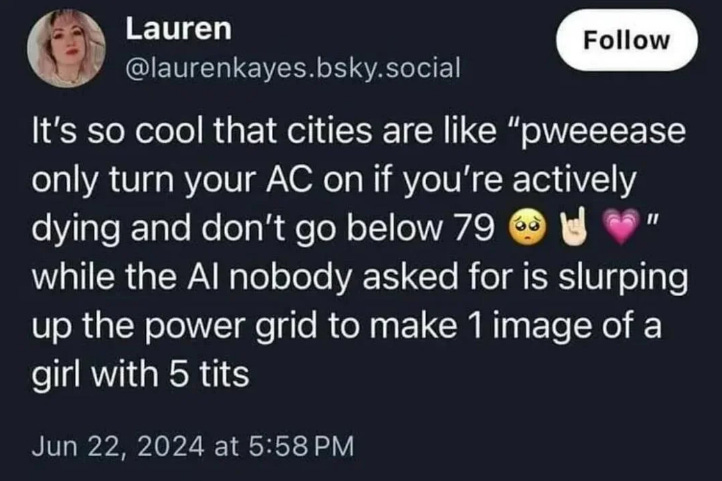
The meme says ChatGPT uses a bottle of water for every question. It’s also pretty wrong. The study it came from says something closer to a bottle per dozens of queries (and even that is skewed by re-use, and closed systems, and a bunch of other things), depending on the model and the data center, and the meme has been distorting outward from there for years. (The people most likely to share that meme tend not to ask the same question about themselves and their lawns. But Anywayyyyyyy.)
The revealing thing isn’t that the numbers are wrong. It’s that the discourse collapses straight into personal moral consumption the moment AI is the subject. Nobody asks whether you personally deserve almond milk before going at California’s agricultural water allocation. Nobody treats individual golf rounds as ethical purity tests. Those are understood as regulatory questions, not personal-virtue questions. AI gets framed differently because a chatbot is an emotionally legible villain in a way that a public utility commission approving a subsidy package... just isn’t. There’s no viral “public utility commission” meme.
It’s the same shape as the bad-art critique. The complaint comes first, and then people go looking for substance to make it true. With the art (and writing) critique, that’s filling in invented “AI tells” on real human work, and frontloading an opinion about quality based on everything BUT the quality. With the water critique, that’s selective outrage about chatbot consumption while ignoring the lawns and the almonds and the golf courses. When environmental concern shows up as “are YOU personally using too much water by asking a chatbot something,” it’s symbolic moral positioning, not infrastructure politics. The bigger water uses that nobody fights this way show what consistent environmental governance would look like, if anyone wanted to actually do it. Residential lawn watering uses more than ten times the water every US data center combined uses. Almonds drink around a sixth of California’s agricultural water on their own. Beef burns through it by the gallon. A single desert golf course can use over a million gallons a day. The selective outrage is the data point. People are choosing to attach environmental rhetoric to AI for the same reason people are attaching copyright rhetoric and quality rhetoric to AI: AI is the most emotionally available villain, and aiming at it doesn’t threaten anyone’s tax incentives.
Sustainable data centers exist. Microsoft built underwater data centers that used zero municipal water and had a fraction of the server failure rate of land-based ones. Stockholm is heating tens of thousands of apartments with waste heat from its data centers. Iceland has been running data centers on geothermal and cold air for over a decade. Closed-loop cooling can cut water use by up to ninety percent and is being deployed commercially at scale. Not every approach scales to every site (Iceland’s geothermal doesn’t help Arizona), but the basic point holds: the tech to build data centers without burning through scarce water exists, and the companies operating in scarce-water areas have chosen not to use it. Because the tax breaks in scarce-water areas are better than the tax breaks in Sweden.
Two-thirds of new US data centers are getting built in water-stressed areas anyway. Companies pick those sites because the tax breaks are better, the power is cheaper, and the local political pushback is weaker. Public utility commissions approve the deals because the local municipalities want the jobs. The environmental cost lands on the people who live there, who tend to have less political weight than the corporations getting the tax break. The same companies running these data centers also run streaming, social media, and cloud. Same companies, same playbook, no AI required. Strip every AI workload off and the siting incentives produce the same problem.
The fight that would actually change this is over siting incentives, water-rights enforcement, regulatory capture, externalized costs. It happens at public utility commission hearings, in environmental impact reviews, in local zoning fights, in state legislatures debating data center tax abatements. None of that is what people are showing up to argue about. They are showing up to argue about whether a chatbot is using too much water. The AI fight is convenient cover for not doing the harder political work, and the harder political work is, you know, the only work that would actually help.
No labor displacement story here. Still a capitalism story. Extract where you can. Externalize the costs to whoever’s nearby. Capture the regulators that are supposed to be checking you. Redirect any pushback at whatever symbol is most convenient. The mechanism works wherever capital operates. Labor is one place. Environmental capture is another. AI is one of the cleanest cases of the redirect in operation we’ve had in a while.
The environmental fight is regulatory, named as personal ethics. The writing fight is labor, named as copyright and “offloading thought and creativity”. The art fight is extraction, named as theft, soulessness, and a supposed drop in quality that gets harder to define every day and was out of the uncanny valley at least a couple of generations ago when it’s done well. Three domains. One source.
It’s. Fucking. Capitalism. Every god damn time.
What We’re Mad About
The strongest objection here is the coordination problem. The people organizing against AI training, pushing for model transparency, and building opt-out systems are making tactical choices given what they think is feasible. If UBI isn’t on the table, copyright litigation IS the closest available tool. So the argument I’m making depends on UBI being more on the table than people are treating it as.
Which it is. Let me say why.
We have done labor displacement before. Many times. Badly.
The sewing machine destroyed home textile labor. Most of those workers ended up in factories under conditions worse than the home work they’d lost. The 1911 Triangle Shirtwaist Factory fire that killed 146 of them is downstream of that displacement. It took a hundred and forty-six dead garment workers in one building before anyone in power took the conditions seriously, which tells you something about the threshold. The printing press destroyed scribal labor. The Catholic Church spent a century trying to suppress it, and the Reformation happened in the gap, which I’m sure the Church was thrilled about. The Luddites were not anti-technology. (Please, for the love of god, can we retire that misunderstanding.) They were skilled textile workers fighting wage suppression they had no other channel to fight. The British government deployed twelve thousand troops against them, more than the Duke of Wellington had taken into Portugal a few years earlier. Frame-breaking became a capital offense. They lost. The word “Luddite” became a slur, which is itself a tell. The slur originated as state propaganda after the crackdown. (We have been reading the textbooks written by the people who won that fight. Pretty much always have been. The textbooks were not on the side of the wage-suppressed.)
Every wave, the fight failed. The labor displacement happened. Conditions only improved, when they improved, after the economy got restructured around the displacement. Factory Acts. Union legalization. Public education. Not at the moment of disruption. Decades after. The displaced workers bore the cost in the meantime.
Artists are getting hit by something that has been moving for two centuries. Factory workers caught it. Telephone operators caught it. Translators, paralegals, customer service reps, bookkeepers, copyeditors. Now it has come for creative work. There was never going to be an exemption. The mechanism doesn’t care what kind of labor it’s commoditizing. The mechanism, annoyingly maybe, has no taste.
So what do you do?
The thing capitalism welded together has to come apart. Survival has to stop depending on selling labor. That’s the actual fight. The lawsuits, the meme campaigns, the technical countermeasures, none of those touch the welding. UBI does.
Every modern UBI pilot at any scale has shown the same shape. People work slightly more on average, or about the same, or a little less while doing things capitalism was previously forcing them away from. Stockton, Finland, Kenya. Alaska has been giving every resident a check from the oil fund for forty years with no measurable employment effect. The only meaningful work reduction came from Mincome in Manitoba in the 1970s, where labor force participation dropped about eleven percent. Almost the entire drop was teenagers staying in school longer and new mothers spending more time with their infants. That’s not people refusing to work. That’s people doing the things capitalism was forcing them not to do. (Picture a kid finishing high school instead of dropping out for a shitty job. Picture a mom getting actual time with a baby. The horror. Won’t somebody think of the economy.)
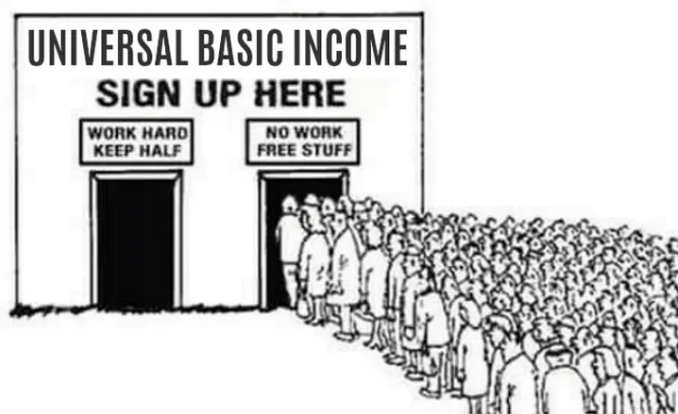
The infrastructure for paying people exists. CARES Act payments hit bank accounts in weeks. The expanded Child Tax Credit cut child poverty nearly in half before exactly one senator blocked the renewal. (One. Person. Like a video game boss on a checkpoint nobody can get past, except this checkpoint costs about a million kids their poverty exit and we just... let it happen.) UBI is held back by politics, not engineering. The block is a small handful of gatekeepers.
People will tell you UBI is not on the near horizon. That’s not a fact. It’s a prediction about current politics from the same political class that said COVID relief couldn’t move in weeks, that the Child Tax Credit wouldn’t cut child poverty in half. The relief checks went out in weeks. The Child Tax Credit cut child poverty in half. The horizon moves exactly as fast as enough people decide to move it.
The biggest AI copyright lawsuits are still working through summary judgment, with trial and appeals after that. UBI could be passing checks before any of them finish.
AI isn’t going away, and pretending it might only creates the same repeated pattern of harm as the many MANY other labour disruptions we’ve had in the past.
AI slop doesn’t stop art. AI is probably coming for at least part of your livelihood at some point, either already, or in the near future. Even things like art are very much not safe from that. The machine was never coming for human creativity... art in every form will continue. What it has been coming for is wage dependency. We’ve never won by trying to make the machine stop. The machine keeps coming.
The other fight is right there. Whether we finally break the cycle and save ourselves yet another economic collapse is... yet to be seen, but I hope we do.